
Early summer Chautauqua musky fishing is jaw-dropping fun
The Western New York Musky Showdown Tournament at Chautauqua Lake last weekend (June 21-22, 2205) was a thrilling two-day event. The competition was fierce, with catch-photo-release (CPR) rules and no use of forward-facing sonar (FFS) permitted. Sponsored by the New York Muskies Chapter 69 club group, the tournament saw most competitors launching from Long Point State Park, with other boat launches at Prendergast Point, Bemus Bay, Mayville Town Park, and many other spots on the 17-mile-long lake also open for action.
Fishing for muskellunge in June can be incredibly productive as the water warms and muskies become more active in their post-spawn period. In the middle of June and into July, musky can become aggressive and respond very well to flashy lures with vibration. Anglers in the know fish the weed edges, breaklines, and shallow flats, but these voracious predators can sometimes be found anywhere.
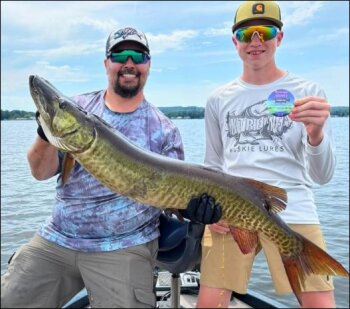
The competition was fierce, but it was the team of Brandon and Gavin Guthrie (father-son), and Joe Dancho who emerged victorious. Their catch of three musky giants, including 45”, 44”, and 35” fish, secured their win. In second place, Doug Coney and Jim Schafer caught a 45” and 36” fish, While Chris Petro and Bobby Kish took third place with 36”, 35” and 33” muskies. The biggest fish award went to the Dave Commons and Blaine Bennett team with a true, thick 45” monster.
The Saturday after-tournament dinner and raffle was held at Mayville Town Park, while the Sunday awards ceremony (and shared secrets for next time) was held at Long Point State Park.
Musky anglers generally use bright colors (orange, black/nickel, chartreuse) on cloudy days and more natural tones (white, perch, black) on sunny days. Early morning is typically best for topwater baits, a favorite tactic ritual for some musky anglers; some say – “just do it!” Baits such as Whopper Ploppers, Hawg Wobblers, and similar forage decoys can be effective with a slow and steady retrieve; pausing now and then is the trick that can generate an explosive strike.
Longer rods help cast large lures with ease and allow for figure-8 boatside maneuvers, sometimes a key to trigger strikes. Musky rods are typically 8 to 9 feet long, heavy or extra heavy power, fast action. Reels are typically size 300-400 baitcasters with a strong drag system (Shimano Tranx 400, Daiwa Lexa 400, etc.) loaded with 80-pound braid and a 100-pound fluorocarbon leader to the lure.
Many June-July musky anglers focus on the 5-12 foot depths of the south basin in Bemus Bay, Ashville Bay, and the Lakewood area, but north basin hotspots also exist. Trolling the deep weedline edge can be a good option if casting slows, but that was not the case last weekend. It was a “rod-in-hand” musky caster's dream team weekend! Hats off to Chairperson Katia Rivers and her team of tournament volunteers from New York Muskies Inc. – Chapter 69 for keeping the event fun, honest, and exciting.
Don't miss out on the action; join us and experience the thrill of musky fishing at Chautauqua Lake. Just remember to keep your toes out of the water!