


Observatory Lecture: LORRI: The Camera That Showed Us Pluto
176 Robbin Hill Rd, Frewsburg, NY 14738
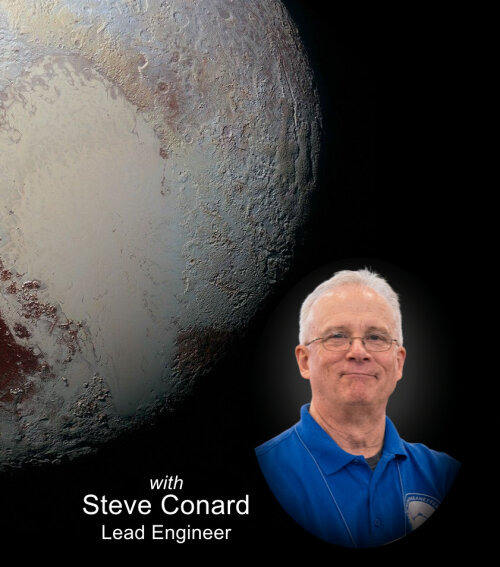
LORRI: The Camera That Showed Us Pluto
A talk by Steve Conard, lead engineer of the New Horizons camera
More info and Zoom link: martzobservatory.org
When New Horizons flew past Pluto in 2015, the world was stunned by a distant, icy world with a giant heart-shaped glacier across its face. Many of the sharpest views came from LORRI, the spacecraft's telescopic camera. Steve Conard, then an optical engineer at the Johns Hopkins University Applied Physics Laboratory, led the team that built and tested it. Now you can hear LORRI's story directly from him.
New Horizons left Earth in January 2006 faster than any spacecraft before it, crossing the Moon's orbit in about nine hours. The spacecraft is about the size of a grand piano and runs on a nuclear power source, because sunlight is too faint for solar panels that far from the Sun. After a 2007 boost from Jupiter, it coasted nearly nine and a half years to Pluto, passing just 7,800 miles above the surface. LORRI's 8.2-inch telescope revealed details a few hundred feet across, including towering ice mountains, flowing nitrogen glaciers, and Pluto's largest moon, Charon. On New Year's Day 2019 the spacecraft flew past Arrokoth, a small, ancient Kuiper Belt object and the most distant world ever explored up close. It is still operating today, billions of miles from home.
Steve will follow LORRI from design, construction, and testing through two decades in space, sharing its images from Jupiter, Pluto, and Arrokoth along with the inside story of the mission. He was LORRI's lead engineer from 2003 through 2024, after 42 years at Johns Hopkins that included NASA's Astro-1 and Astro-2 shuttle missions and the FUSE satellite. As both a spaceflight engineer and a lifelong amateur astronomer, he offers a view of the mission few speakers can match.
Now retired in Wellsboro, PA, Steve is a founding member of the Pennsylvania Wilds Astronomy Club. Through his work with the International Occultation Timing Association he has discovered two asteroid moons, and asteroid 149163 Stevenconard is named in his honor.
We warmly encourage you to join us in person. Watch on the big screen with fellow stargazers and put your own questions to Steve during our always-lively Q&A. If the weather cooperates, the evening will end with guided tours and viewing through our telescopes. Please dress for the elements: our classroom is heated, but the observatory domes are not.
Can't make it in person? The talk is also live on Zoom.