


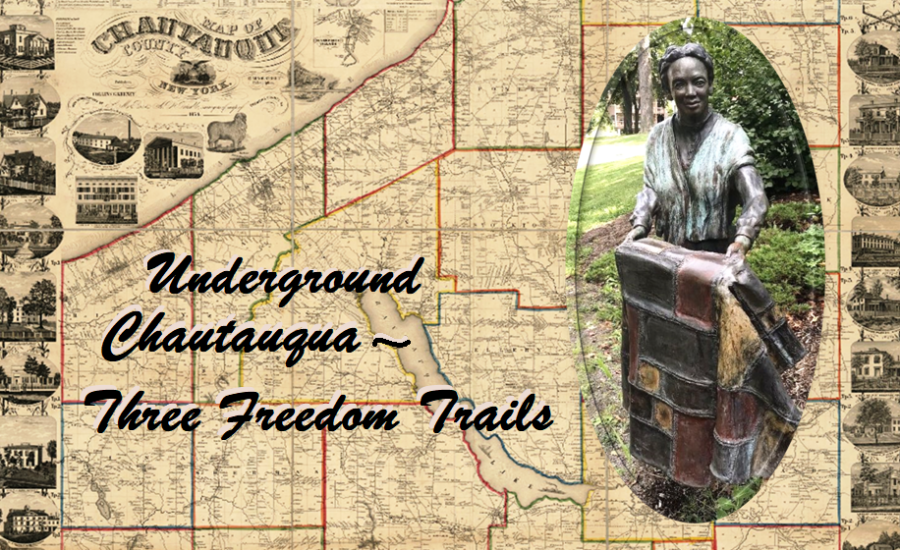
Learn about the Underground Railroad in Chautauqua County through a website, map, and film.
The film Underground Chautauqua: Three Freedom Trails premiered at the Fredonia Opera House on November 10, 2022.
Showcasing the persons identified as anti-slavery operatives in Chautauqua County, NY, the film utilizes the Chautauqua County Anti-slavery Map to provide an aerial tour of three overlapping freedom trail systems which stretched through the area.
Narrators are Nicholas Gunner, developer of the interactive map in 2013; Dr. Saundra Liggins and Dr. Jennifer Hildebrand, developers of Underground Railroad coursework at SUNY Fredonia; and Chautauqua County native Elijah Toro.
The film was written, produced, and directed by Wendy Straight, MA, PLS (retired), a research colleague of SUNY Fredonia Emeritus Dr. Douglas H. Shepard and SUNY Oswego Emerita Judith Wellman.
"The Underground Railroad is often mythologized, but there exists no documentation of hidden rooms or tunnels in Chautauqua County. Instead, there is abundant documentation of hundreds of anti-slavery households." -- Underground Chautauqua: Three Freedom Trails, 2022
The interactive Chautauqua County Anti-slavery Map includes hundreds of Underground Railroad and Abolitionist households.
Black History in Chautauqua County from 1835 to 1860: Museums & Sites to Visit
John Little and Henry Davis were famous in the North County. John Little was named as a fellow conductor of the Underground Railroad, in a published memoir written by another confirmed conductor, Eber M. Pettit. Davis Avenue in Fredonia NY was named for a time in honor of Henry Davis. Learn more about these men, their families, and additional Persons of Color in the North County during this period, in the displays located at the Darwin R. Barker Museum, 7 Day Street in Fredonia.
Rev. Samuel Ringgold Ward was a famous, abolitionist speaker. He visited the Westfield NY area, where Elial T. Foote’s volumes of historical papers are now housed. Ward corresponded with Foote, who was also an abolitionist. They shared an attempt to motivate politicians to end slavery in America. Learn more about these men, their families, and additional anti-slavery persons in and around Westfield during this period, in the displays found at the McCLurg Museum (Chautauqua County Historical Society), 20 East Main in Westfield.
Catherine Harris discussed her work as an Underground Railroad stationmaster in a published interview around the time of her 100th birthday. Her bronze statue, a monument to her work and sacrifice, is located in the Dow Park in Jamestown NY, not far from her former home. The park is on W. 6th Street, across from the Prendergast Library, with a crosswalk at Washington Street. Learn more about Harris and her family in the displays at the Fenton History Center, 67 Washington Street in Jamestown.
The famous Rev. Jerome Wesley Loguen was connected to western New York as the son-in-law of William Storum, who lived near Jamestown. Like Catherine Harris, Storum and his family operated an Underground Railroad station, and it was the Storum farm where freedom seeker Harrison Williams was captured. Learn more about these people, and other Persons of Color who were in and near Jamestown during this time, in displays found at the Fenton History Center, 67 Washington Street in Jamestown.